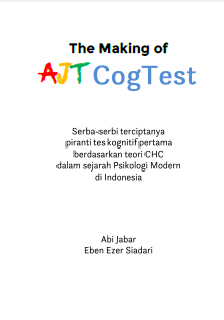
AJT CogTest: A Journey to Build Indonesia’s Own Cognitive Assessment
AJT CogTest began with a bold question: could Indonesia build a cognitive assessment that was not merely adapted from overseas instruments, but truly grounded in Indonesian educational realities, language, culture, and student diversity?
The project brought together Yayasan Dharma Bermakna, PT Melintas Cakrawala Indonesia, and the Faculty of Psychology at Universitas Gadjah Mada. With guidance from international and Indonesian experts in psychometrics and CHC theory, the team designed a cognitive test battery intended to help schools and psychologists see each learner more completely. The goal was not to label children as simply “smart” or “not smart,” but to understand their unique pattern of cognitive strengths and learning needs.
The work was long and demanding. The team selected relevant CHC broad abilities, wrote and reviewed test items, tested prototypes, refined the instrument, and conducted a large norming process involving thousands of Indonesian children. Field teams travelled to many schools, including difficult-to-reach areas, carrying test kits, coordinating with schools, and collecting data under real-world conditions.
The result was AJT CogTest, described in the book as Indonesia’s first modern cognitive test based on CHC theory. More than a test battery, the project became a national milestone: a locally developed tool that reflects Indonesian learners and supports more evidence-based decisions in education, psychology, and human development.
Project Snapshot
Challenge
Indonesia needed a comprehensive cognitive assessment built for local context, rather than relying mainly on imported or adapted instruments.
Approach
The project combined CHC theory, expert psychometric supervision, item development, pilot testing, revision, and national-scale norming.
Contribution
AJT CogTest offers educators and psychologists a richer way to understand student potential, learning challenges, and individual cognitive profiles.
Why This Project Matters
AJT CogTest shows that human capital development starts with understanding people accurately. By building an assessment around local needs and global scientific standards, the project reflects Smart PHCM’s spirit: connecting evidence, people, and practical transformation.
Source note: Full story is written in a book with title The Making of AJT CogTest.
Book Cover